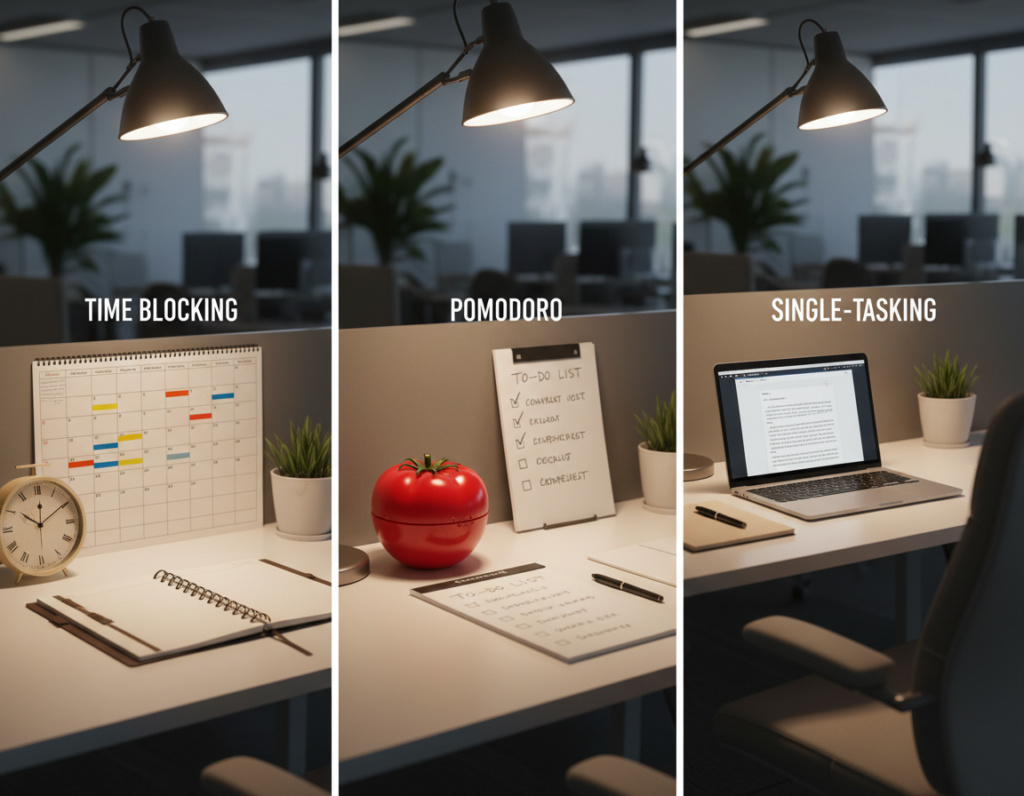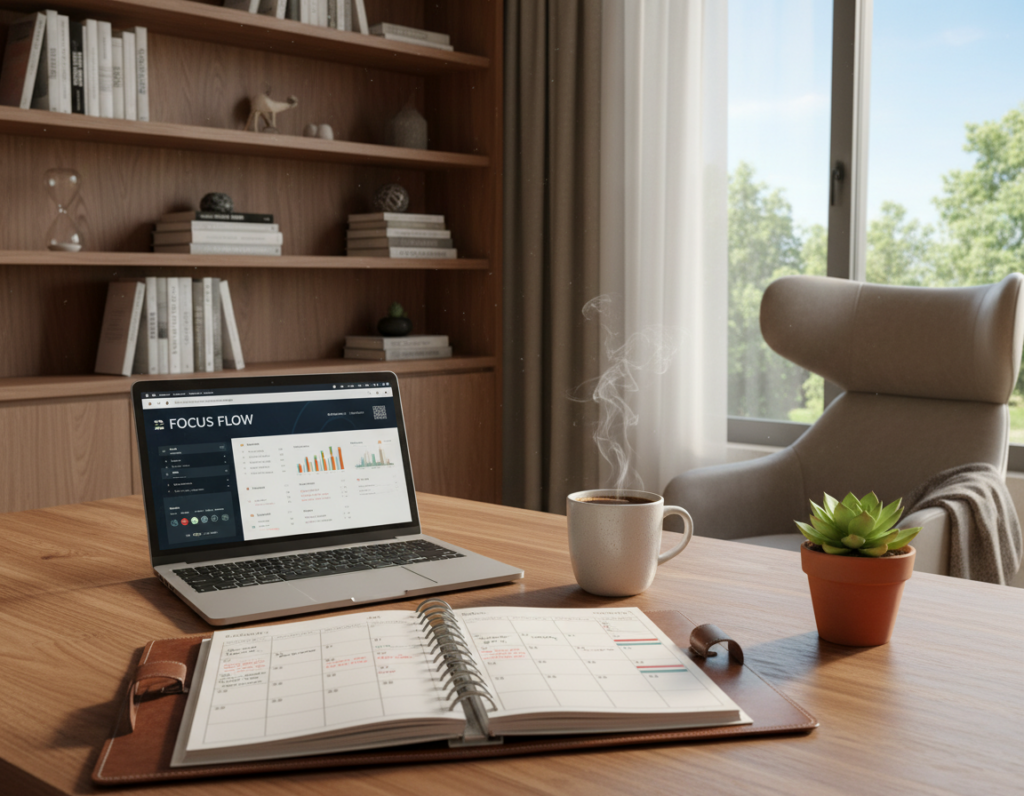
A focus-first workday means you plan the best part of your mind for high-impact tasks before reactive requests pull you away.
This guide shows practical ways to shape a realistic work day around attention and results. It is built for real schedules, meetings, and common distractions.
Expect step-by-step methods — set priorities first, plan time, then use execution techniques like Pomodoro and batching. You will get tips on controlling interruptions and creating an environment that supports sustained attention.
The core promise is simple: better productivity and higher quality without relying on willpower alone. Use systems that make attention a repeatable outcome, not a trait you must have.
Think of attention as a skill and a workflow result anyone can train. The benefits at work are clear: finish tasks, reduce errors, and show steady progress toward goals and a healthier work life.
Why a Focus-First Workday Matters in the Modern Workplace
In today’s fast lanes, protecting deep attention is a rare competitive edge. Digital noise, tighter deadlines, and constant context switching make concentrated work more valuable than ever.
Deliver more and deliver better. When you preserve concentration for a single task, mistakes drop and rework falls. Teams produce stronger outcomes because attention stays on the job instead of scattering across tasks.
Momentum grows when you protect long stretches of attention. The brain reuses context, so you move faster and tasks feel repeatable rather than chaotic. That rhythm helps you stay focused and build reliable progress.
Steady attention helps with stress management. Trusting your ability to execute makes deadlines feel manageable and protects work quality under pressure. Being busy isn’t the same as getting results; deep attention creates measurable output, not just activity.
- Competitive advantage: less context switching, clearer decisions.
- Better outcomes: fewer errors, less rework, higher quality.
- Lower stress: calm under deadlines and sustained cadence.
Use the rest of this guide as a practical way to stay concentrated without burning out or relying on perfect motivation. The following sections show concrete steps to enter, maintain, and reset attention across your day.
| Benefit | What Changes | Result |
|---|---|---|
| Less context switching | Longer work blocks | Faster completion, fewer errors |
| Consistent rhythm | Protected task sequences | Repeatable quality and speed |
| Lower stress | Clear expectations and goals | Calmer deadlines and better output |
| Efficient output | Prioritized daily goal | Higher impact per hour |
How Focus Works: Enter, Maintain, Then Reset Your Attention
Sustained attention comes from a rhythm of entering, holding, and intentionally stepping away. Treat concentration as a cycle so you stop expecting nonstop intensity. The brain performs best in phases, and designing those phases makes results repeatable.
Entering a focused state on a single task
Start with clarity: name the next task and the desired outcome. Remove obvious distractions and give your mind a short ramp-in of three to five minutes to settle.
Small rituals—closing tabs, setting a timer, or jotting one sentence of intent—help the brain shift into a work state faster.
Maintaining and redirecting attention when difficulty rises
When tasks get hard, attention drifts and friction appears. Instead of switching tasks, use micro-steps: simplify the next action, reduce scope, or switch to a related subtask.
Redirecting keeps momentum and prevents wasted context switches. Dopamine and epinephrine naturally rise when work feels engaging, so shape tasks to stay interesting.
Defocusing on purpose with short breaks to recharge
Reset on purpose: take short breaks to defocus before another work bout. Brief pauses preserve brain energy and improve overall ability to return to deep work.
Use consistent break timing and a simple ritual to mark the end of a session. This makes your workflow a sustainable way to improve focus over time.
“Design your environment and workflow so attention becomes a byproduct of good systems, not a test of will.”
Focus Productivity: Set Priorities Before You Touch Your To-Do List
Choose one realistic goal that defines what “winning the day” looks like. Naming a clear outcome makes it easier to say no to low-value requests.
Choose a realistic daily goal that guides every task
Pick a single achievable goal for the day. Make it specific and outcome‑oriented, like “submit draft” or “send proposal.”
Prioritize tasks by impact, urgency, and effort
Sort items using an impact/urgency/effort lens so small chores don’t bury high-value work. Use the impact/urgency lens to decide what to do now, schedule, delegate, or drop.
Break big tasks into smaller chunks you can finish
When a task will take longer, split it into clear steps with end points. Assign time blocks and name the next physical action to avoid stalling.
Quick checklist:
- Name one daily goal.
- Prioritize by impact, urgency, effort.
- Break large tasks into short, finishable steps.
| Priority Lens | Example Task | Suggested Time |
|---|---|---|
| High Impact / Low Effort | Approve budget proposal | 30–45 minutes |
| High Impact / High Effort | Draft client presentation | 2–3 blocks (90–120 minutes) |
| Low Impact / Quick | Answer routine emails | 15 minutes |
| Delegate / Defer | Compile weekly metrics | Schedule or assign |
“Clear goals make it easier to return attention to the right task after interruptions.”
Plan Your Day Like a System: Time Management That Actually Sticks
Design your daily plan as a repeatable system, not a to-do scramble. A simple workflow turns intentions into reliable habits you can use every work day.
Timebox each task
Assign a specific amount of time for every task and treat it like an appointment. Protect that block as you would a meeting.
Concrete rule: set a timer, work the slot, then review. This reduces re-planning and helps you get more done in less time.
Use a clear order of operations
Create a short sequence to cut decision fatigue. Example: 1) Review the one daily goal, 2) pick the top two tasks, 3) block time for the highest-impact item.
Following an order keeps your mind from guessing what to do next and saves willpower for real work.
Beat procrastination by naming the next action
When a task feels big, define the next physical action—write one sentence, open a file, or draft a subject line. Small actions lower resistance.
Keep one central to-do list so nothing gets lost in scattered notes. This single list reduces mental clutter and helps improve productivity over the week.
| Planning Element | Example | Time | Benefit |
|---|---|---|---|
| Daily goal | Submit client draft | Morning block (90 min) | Clear outcome for the day |
| Timebox | Write report sections | 45 min per section | Fewer interruptions, steady progress |
| Order of operations | Review, act, reset | 3-step flow | Less decision fatigue |
| Next physical action | Create file, write line | 5–10 minutes | Reduces procrastination |
“Plan the day so decisions happen once, not in the moment when pressure rises.”
Use the Pomodoro Technique for Focused Work Without Burnout
A timed sprint model turns vague work into short, doable commitments that protect your mental energy.
Why timed work sprints improve concentration and output
The Pomodoro Technique uses repeated, timed work sprints followed by a break. This makes tasks feel finite and reduces the urge to switch tasks.
Clear endpoints raise urgency without panic, which improves concentration and the ability to return to work after interruptions.
How to choose the right minutes for work and rest
Start simple: 25 minutes of focused work, then a 5-minute break. For harder tasks try 50 minutes with a 10-minute break.
Adjust by energy. Shorter slots help shallow tasks. Longer slots suit deep tasks that need sustained concentration.
When to extend a session if you’re in flow
If you hit flow, extend one sprint by 10–15 minutes. Limit extensions to prevent fatigue. If you feel tired, take the scheduled break instead.
| Goal | Work minutes | Break minutes | Use case |
|---|---|---|---|
| Quick tasks | 25 | 5 | Emails, small edits |
| Deep work | 50 | 10 | Drafts, analysis |
| Flow maintenance | 60–75 | 10–15 | When momentum is strong |
Use breaks correctly: step away, reduce stimulation, and avoid new distractions so the brain can rest and you return refreshed.
Single-Tasking and Task Batching to Complete Tasks Faster
When you handle one task at a time, you spend less time restarting mental context. This reduces errors and shortens the total time to finish common work.
Why single-tasking often wins: fewer resets between tasks, fewer mistakes, and less time lost reloading context. The net result is faster completion and clearer output.
Group similar tasks to protect rhythm
Batching means grouping related tasks like messages, edits, or admin into one block. That keeps your mind in the same mode and reduces costly switches.
- Batch message replies into one 30-minute window.
- Batch document edits into a single editing block.
- Batch short meetings into a scheduled meeting window.
Finish the task at hand before moving on
Finish the task at hand as a rule: resist switching when interruptions tempt you. Completing a focus task builds momentum and makes the next block easier to start.
Common habits that break batching: constant inbox checks and ad hoc pings. These will be addressed in the distractions section so you can protect your rhythm.
| Approach | Example | Block Length | Benefit |
|---|---|---|---|
| Single-tasking | Write one report section | 45–60 min | Fewer edits, faster finish |
| Message batching | Reply to email and chat | 30 min | Less context switching |
| Admin batching | Expense reports and forms | 60 min | Complete tasks faster |
| Meeting window | All short calls in afternoon | 90–120 min | Protected deep morning work |
“Finish one thing well; momentum takes care of the rest.”
Cut Distractions at the Source: Social Media, Phone, and Digital Noise
Small changes to how you handle your phone and apps can stop repeated attention breaks. Identify the main digital distractions at work: social media, constant text messages, and rapid app switching.
Create friction for social media during work hours
Log out of accounts, remove apps from your home screen, or use website blockers for scheduled blocks. Keep your phone in another room when you need long, uninterrupted time.
Tame texts, notifications, and app switching
Disable nonessential alerts and set a few times each day to check messages. Use built-in focus modes or Do Not Disturb to guard high-value blocks.
Use a distraction list to park thoughts
Keep a short list where you note ideas like “look this up” or “reply later.” This simple list lets your mind let go and helps you stay focused on the next action.
Replace reactive scrolling with intentional breaks
Choose a real break: a short walk, refill water, or light stretch. These actions restore energy faster than scrolling and help you return with clearer attention.
Quick recovery: when pulled away, note what caused the distraction, name the next physical action, and restart a short timer to rebuild momentum.
Make Your Workspace Focus-Friendly
A well-arranged workspace directs your attention and cuts the small interruptions that add up.
Optimize desk and room setup for fewer interruptions
How your desk sits in the room changes how often people and noise interrupt your work.
Baseline desk setup: keep only the current task materials on the desk, close unrelated tabs, and place required tools within arm’s reach.
Reduce noise and visual clutter that pull attention away
Remove obvious visual hooks like unused notes, open devices, or decorative things that invite looks or fiddling.
Mitigate noise with headphones, a white-noise machine, or moving your chair so your back faces traffic. Signal when you are not available with a closed door or a visible sign.
Why this matters: a tidy desk and a calm room cut micro-interruptions. Reduced interruptions lower errors and raise the overall quality of work.
| Issue | Simple fix | Result |
|---|---|---|
| Too many things on desk | Clear surface; leave only task items | Less visual pull; faster start |
| Loud room noise | Use noise reduction or relocate | Longer uninterrupted blocks |
| Open tabs/devices | Minimize and close extras | Fewer task switches |
| Shared space interruptions | Set seat position and signal availability | Fewer drop-in disruptions |
Make changes into small habits: reset the desk each evening so tomorrow’s setup is ready. This simple ritual becomes a repeatable way to protect attention and keep work steady.
Train Attention and Support Your Brain Every Day
Building attention is like strengthening a muscle — brief, consistent practice matters more than long one-offs.
Meditation and small mindful resets help you notice distractions and return to work faster. Start with two-minute breathing checks between tasks. That short habit trains awareness and reduces time lost after interruptions.
Meditation that fits a real workday
Begin with 2–5 minute sessions. Breathe, count, or follow a simple body scan. Repeat this every day and increase slowly to build skill.
Use a reminder before a meeting or after a sprint to restore calm. Over weeks, these resets will improve focus and shorten recovery from distractions.
Daily body and sleep habits that support attention
Sleep and regular rest stabilize energy and protect concentration. Drink water and time meals to avoid energy dips that trigger checking apps.
Movement matters: short walks or standing breaks between long work blocks refresh the mind and the brain. These actions keep this practice sustainable for long-term life balance.
| Practice | Duration | Benefit |
|---|---|---|
| Meditation reset | 2–5 min | Faster return of attention |
| Hydration & meal timing | Throughout day | Steadier energy, fewer dips |
| Movement break | 5–10 min | Refreshes mind and concentration |
“Train attention with short, daily habits so your mind and brain stay ready without burning out.”
Align Goals With Your Team to Protect Deep Work Time
When a team shares clear priorities, individual work blocks stay intact and interruptions drop.
Why alignment matters: without shared priorities, unclear asks, ad hoc meetings, and random pings steal time and break concentration. These distractions raise rework and lower quality.
Use OKRs and the rule of five
OKRs narrow what the team will do. Limit objectives to three to five items and keep three to five key results per objective. This rule keeps the team’s goal set manageable and lets people plan deep work that supports outcomes.
Translate OKRs into calendar behavior
If a task does not support an Objective or key result, it should not routinely interrupt protected blocks. Agree on shared focus blocks on the calendar so everyone knows which time is off-limits for quick asks.
Meeting and messaging norms: agenda-first meetings, default short calls, and agreed response windows cut needless disruptions. These simple rules help the team stay focused and improve productivity.
“Aligning goals across the team reduces late-day fire drills and protects the time needed to deliver results.”
Conclusion
Treat attention as a daily routine you can shape with small, repeatable actions. Use clear priorities, block your calendar, apply a method for execution, and remove distractions at the source to make this real.
Remember the three phases: enter, maintain, reset. Name the next action, protect short work sprints, and take planned breaks so you don’t push endlessly.
Start simple this week: pick one daily goal, timebox two deep work sessions, and batch communication once or twice. These small steps build , focus productivity without relying on perfect motivation.
Measure progress by completed tasks and quality, not by hours logged. Over time, steady systems produce better results and stronger habits for work and life.