Anúncios
First-principles thinking helps professionals break big problems into clear facts and shaky assumptions. This approach forces you to question what truly matters and rebuild solutions from the basic, verifiable basis.
Leaders like elon musk used this method to reinvent whole industries, using it to design rockets and reshape aerospace. The process costs more mental energy than copying how others act, but it makes original ideas possible.
Using first principles means you avoid the trap of analogy and spot opportunities others miss. This short guide shows how to apply the method, test assumptions, and craft practical solutions grounded in physics and reality.
For a deeper look at how top leaders drive decisions with this model, see a practical example and insights from industry thinkers here.
Understanding First Principles Thinking
At its core, this method asks you to strip ideas down to the few facts you cannot deny.
Anúncios
Aristotle gave this concept a name over two thousand years ago when he said a first principle is “the first basis from which a thing is known.”
Scientists use the same habit. They test what is proven and discard assumptions that rest on old models. That approach forces clear, testable foundations for each decision.
Defining the Core Concept
Boil a process into its irreducible parts. Ask: what must be true for this system to work? Answering that exposes the raw facts you can build on.
Anúncios
The Difference Between Form and Function
Many people chase the shape of a solution and miss the job it must do.
- Form vs function: A bag’s design may look neat, but the function is effective storage.
- Deconstruct systems like John Boyd’s thought experiments to find efficient alternatives.
- Work one or two layers deeper than usual to reveal new solutions.
The Philosophical Roots of Reasoning
Ancient philosophers framed rigorous ways to separate stable truths from fleeting opinions.
Plato and Aristotle began the Western effort to find core facts that do not crumble under scrutiny. Their work aimed to reveal the underlying rules that govern knowledge and social life.
Centuries later, René Descartes added a disciplined method called Cartesian Doubt. He taught us to question every belief until only indubitable claims remain. This way shaped how later thinkers approach proof.
Physicist Richard Feynman warned against rote learning. He argued that when people memorize without grasping foundations, their knowledge breaks in new situations.
The scientific method echoes this heritage: test, try to falsify, and rebuild knowledge. Studying these historical texts helps professionals craft a durable mental model for decision-making.
“One must question assumptions to reach truths that survive scrutiny.”
- Plato and Aristotle sought the basic facts of reality.
- Descartes used doubt to strip away unreliable claims.
- Feynman warned that shallow learning harms adaptability.
For practical ways to apply these lessons to focus and discipline, see practical thinking strategies.
Core Techniques for Breaking Down Problems
Simple, repeatable tools let professionals probe assumptions and find real causes.
Socratic Questioning
Socratic questioning forces clear, step-by-step analysis. It asks targeted questions that clarify thinking, test evidence, and expose hidden assumption.
This way reduces emotional reactions and keeps teams focused on verifiable facts.
The Five Whys Method
The Five Whys is a direct root-cause process. Ask “why” until you reach the reason behind a situation.
Often you find people follow tradition instead of a reasoned process. That reveals low-value work and costly habits.
Identifying Irreducible Truths
Dig deep until no further deduction is possible. Those irreducible truths become the foundation for durable reasoning.
Doing this takes time and humility. You must accept gaps in knowledge and rebuild from facts, not analogy.
“Each question should reveal the assumptions that shape a specific professional situation.”
- Socratic questioning clarifies and challenges evidence.
- Five Whys exposes root causes of a problem.
- Identifying irreducible truths grounds your reasoning in facts.
Lessons from History and Modern Innovation
Examining how items are made, down to basic substances and physics, reveals paths to major change.
Elon Musk found that material cost made up only about 2% of a typical rocket’s market price. That insight pushed him to assemble parts from raw materials and rethink the whole build.
By founding SpaceX, Musk cut launch costs nearly tenfold. This shows how a company can overturn models when it treats a problem as an engineering question, not a fixed market fact.
- Johannes Gutenberg fused a screw press with movable type, paper, and ink to create mass printing.
- Looking at materials and the process often reveals low-cost swaps that change outcomes.
- When people rebuild from core facts, they create new, scalable solutions.
“Great innovation often starts by refusing to accept how things have always been done.”
Why We Often Rely on Analogy Instead
When pressure mounts, people default to familiar designs. Copying a visible form feels faster and safer than rebuilding the function from scratch.
The rolling suitcase shows this clearly. Bernard Sadow saw a worker roll a heavy machine and, decades after chariots and carts existed, combined wheels with a bag. That simple recombination waited years because others accepted the bag’s shape instead of its job.
The Mental Cost of Original Thought
Original work forces you to discard comfort and test basic facts. That mental cost discourages many people from deeper analysis.
Common effects:
- Reliance on analogy because it is mentally easier than rebuilding a solution.
- Projection of form rather than projection of function, which blocks true innovation.
- Creative stagnation when teams mimic others instead of composing new ideas.
“Copying a form is cheaper in the short term; reframing a problem pays off later.”
Applying First Principles to Professional Challenges
Start by stripping a work problem down to its core goal and measurable facts.
Identify the one outcome that matters most for your team or company. Then list every assumption that stands between you and that outcome.
Look at Derek Sivers and CD Baby. He focused squarely on customer happiness and removed costly extras like large offices. That choice let him scale to $4 million in monthly revenue without outside funding.
Elon Musk uses a similar approach at SpaceX. He questions the cost of each rocket part and the physics behind flight to cut overall cost. This method turns vague debates into testable experiments.
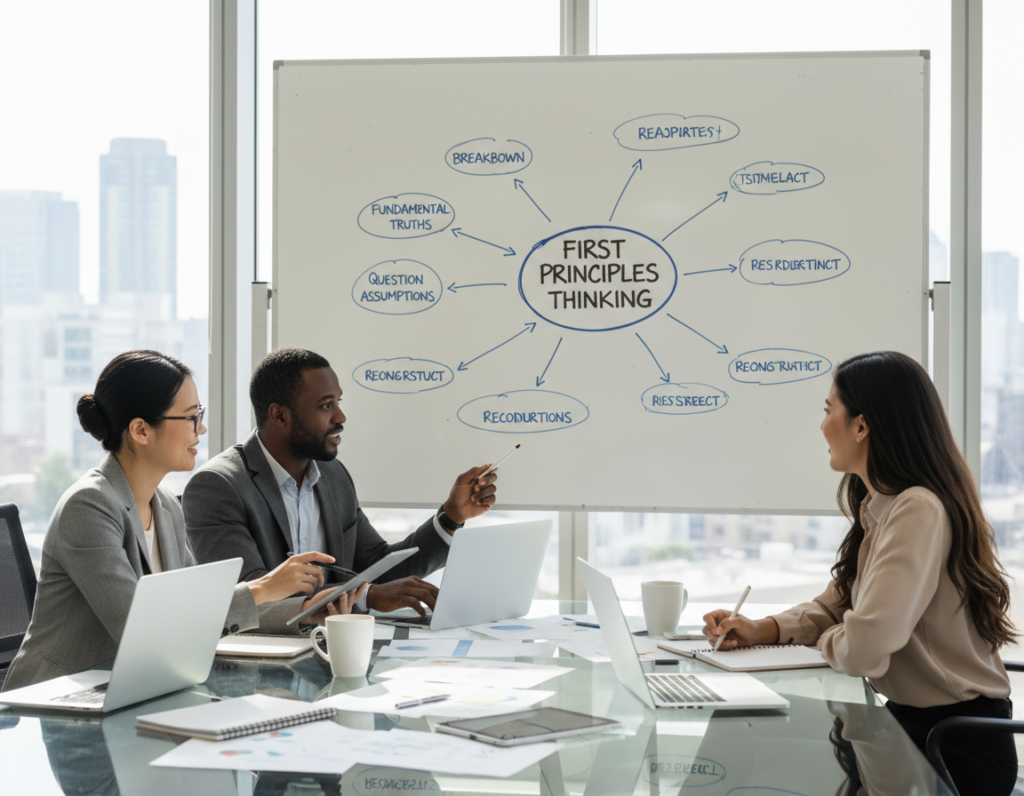
- Define the goal: state the measurable result you need.
- List assumptions: mark which can be tested and which are opinions.
- Rebuild the process: design only what is necessary to reach the goal.
“Ask what must be true for success, then remove everything that does not contribute.”
Common Roadblocks to Independent Thought
A common obstacle at work is accepting “the way we’ve always done it” as the final answer.
“Because I said so” kills momentum in families and firms alike. When leaders use it, teams stop asking why and copy rituals instead of solving the real problem.
Many people go defensive when asked to explain decisions. That reaction hides gaps in knowledge and blocks honest review. Groupthink and fear of looking wrong make teams repeat old patterns and lean on analogy instead of testing facts.
“Challenge the default and you make space for better solutions.”
- Accepting custom: obeying the old way enforces low-value work.
- Defensiveness: explaining actions often exposes missing first principles and forces learning.
- Model curiosity: elon musk shows how questioning the status quo can turn a costly rocket into a cheaper process.
- Risk tolerance: being okay with error is central to independent thought.
Strategies for Building Knowledge from Scratch
Good learning starts by choosing the few variables that will actually move the needle in your work.
Focus on three to five factors that change outcomes. That stops you from consuming noise and saves time.
Optimizing for Variable Outcomes
Identify high-impact variables. Investors and experts avoid reading everything. They track the specific signals that affect long-term results.
Use models that map cause to effect. For a rocket or a product, break things down to raw materials and function. That reveals where you can cut cost and boost performance.
Challenge limiting beliefs. The idea that all good ideas are taken stops people from experimenting. Apply first principles to reframe the problem and find fresh ideas.
- List the 3–5 inputs that change your metric most.
- Design simple tests to measure each input.
- Store and retrieve facts in a compact system so memory works for you.
- Study examples like Elon Musk to learn how materials and physics guide choices.
“Focus on the few variables that matter and you make steady, testable progress.”
Conclusion
Conclusion: Durable change begins by building from simple, testable facts. Mastering first principles thinking rewires how you solve work problems and opens routes that analogy often hides.
Apply the method consistently. Challenge assumptions, pick the few variables that matter, and run small experiments. Over time, this grows into clearer judgment and louder impact.
The path is hard but rewarding. People who adopt these ideas create non-linear returns in innovation and career growth. For a practical primer on this approach, see the first principles guide.
Final note: the way you approach a problem matters as much as the solution. Make the habit of rebuilding from the ground up and your decisions will keep getting better.