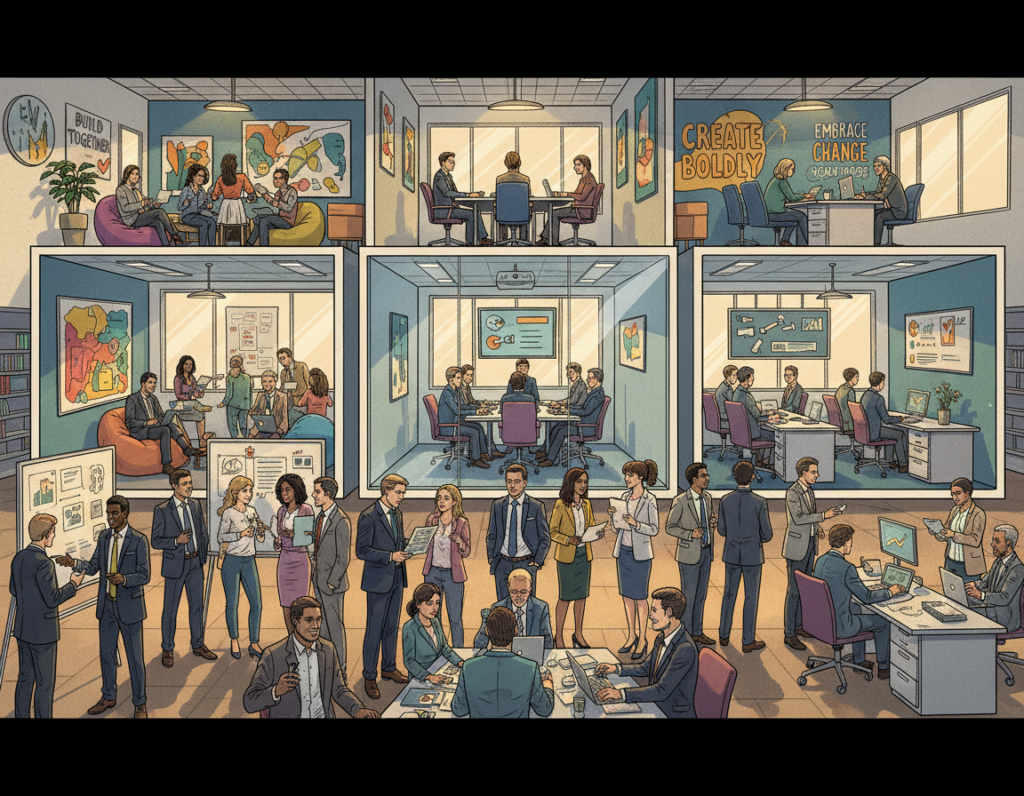
Can intentional habits at work beat perks and drive long-term success?
You are not building perks. You are designing an operating system that shapes how people decide, behave, and collaborate.
Start by assessing what exists, then define what you want. Operationalize that through leadership, people programs, and metrics. Great Place To Work research links top employers with far stronger long-term returns, proving that measured culture relates to business outcomes.
This guide walks you from definition to measurement. You will see clear steps on mission and values, leadership behaviors, belonging and inclusion, programs, communication, and what to measure.
It is written for founders, HR leaders, and managers who want a practical blueprint. Expect concrete examples, observable behaviors, and metrics you can track to prove progress.
What corporate culture really is and why it shapes business success
Organizational culture is the set of everyday choices that shape how people act, decide, and relate at work. It’s the practical answer to “what really happens here” — including decision-making, conflict handling, communication norms, and what gets rewarded.
Organizational personality in today’s workplace
Your company’s personality matters more now that teams are remote, cross-functional, and expected to move fast. That personality affects speed of decisions, quality of collaboration, and the employee experience that drives retention and innovation.
Visible signals versus invisible drivers
Visible signs include mission statements, values posters, policies, and workspace layout. Invisible drivers are unwritten rules, who gets heard, promotion patterns, and the stories people repeat.
Perks versus trust
Perk-based programs (free lunches, fun rooms) help morale briefly. Trust-based environments — fairness, predictable leadership, and respectful feedback — create sustainable performance and engagement.
What the data shows
Great Place To Work reports that Fortune 100 Best Companies to Work For delivered cumulative returns of 1,709% since 1998 versus 526% for the Russell 3000. That correlation supports the idea that strong internal norms influence execution, retention, and customer outcomes. You’ll treat that as evidence, not a guarantee.
Before you change anything, you need an accurate read on both visible and invisible layers. That measurement is the next essential step.
For practical frameworks and assessment tools, see improve company culture.
Assess your current organizational culture before you try to change it
Measure what’s happening now so your next moves target real gaps, not assumptions. Start with a baseline mindset: you can’t manage what you don’t measure, and you will need benchmarks to prove progress.
Pulse surveys and eNPS
Run short, frequent pulse surveys that include an eNPS question (0–10) to quantify advocacy. Segment results by team, tenure, location, and manager to reveal patterns in employee satisfaction and engagement.
Qualitative methods
Use focus groups and one-on-one interviews to unpack survey scores. These conversations surface what people won’t write and where trust breaks. Observe meetings: note who speaks, who gets interrupted, and how decisions are finalized.
Audits, 360 feedback, and exit signals
Perform a cultural audit and policy review to spot misaligned practices—where pay, performance, or processes contradict stated values. Use 360-degree feedback to reflect leadership behavior back to the organization.
Collect themes from exit interviews as an amplifier for turnover causes: favoritism, lack of growth, burnout, and poor manager quality. Benchmark internally and by industry to set realistic targets.
Output: a concise culture diagnosis — list top strengths to protect, top gaps to address, and three observable behaviors you will prioritize first. Document this and link actions to metrics so improvements are visible.
For a broader resilience perspective, review practices that help companies survive market shifts: survives market trends and change.
How to build a strong corporate culture with the elements that matter most
Focus on a short set of elements that actually move the needle for employees and results. Instead of chasing every program, prioritize the eight evidence-backed components that predict trust, retention, and performance.
Credibility, respect, and fairness form the base layer. Employees watch consistency, listening, and equitable opportunity. When leaders act predictably and reward fairly, trust grows and discretionary effort follows.
Pride and belonging are emotional levers. Pride in the job, pride in the team, and pride in the company each boost satisfaction and retention. Research shows pride correlates sharply with workplace advocacy.
Effective leadership means aligning words and actions, avoiding favoritism, and showing competence plus approachability. Leaders who coach, admit mistakes, and make fair decisions raise the overall signal employees use to judge the workplace.
Company values guide daily decisions better than rule-heavy systems. Values speed judgment in ambiguous moments; rules can slow execution and signal low trust.
Innovation needs psychological safety: open idea-sharing without punishment. When people feel safe, experimentation increases and innovation outcomes improve.
| Element | Daily behavior | What to measure |
|---|---|---|
| Credibility / Respect / Fairness | Consistent communication; unbiased promotions | Manager-action alignment (survey), promotion equity |
| Pride & Belonging | Public recognition; inclusive team rituals | eNPS, retention by team, pulse on “employees feel valued” |
| Leadership & Values | Leaders model values when deciding under pressure | 360 feedback, values-aligned decision audits |
| Innovation | Idea-sharing in meetings; safe post-mortems | Number of experiments, innovation sentiment, idea adoption rate |
Define your mission and company values so your teams can make better decisions
Make mission and values practical, tested, and visible. Don’t stop at words on a wall. Create a repeatable process that produces clear behaviors your people will use when faced with trade-offs.
Step-by-step refresh
- Gather input from representative workshops across functions and levels.
- Identify recurring themes and write plain-language drafts.
- Test clarity with small groups, revise, then secure executive commitment.
Involve employees without a popularity contest
Ask workshop groups for specific behaviors tied to each value. Focus on examples like “asks for help” or “shares credit.” That keeps the work practical and reduces performative answers.
Common values-to-behavior mismatches
Watch for gaps that create cynicism: claiming collaboration but rewarding solo wins; saying people-first while tolerating chronic overload; promising transparency then surprising teams with reorganizations.
Embed values into systems
Turn values into 3–5 decision questions per value (for example, “Will this choice protect fairness?”).
Reinforce via onboarding scripts, weekly all-hands language, manager 1:1 templates, and review criteria. Align recognition with behaviors — peer shout-outs, cross-team wins, and ethical choices, not just raw results.
Governance
Review values annually and log violations as learning moments. This keeps the process transparent and reduces politics, improving long-term trust and performance.
Build trust through leadership behaviors employees can see every day
Employees notice patterns, not promises; trust is the sum of consistent leadership acts. Trust is earned by repeatable actions you and your leaders show in regular moments, not by one-off speeches.
Transparency cuts rumor-driven resistance. Use a simple playbook when you announce change: current state, desired future, constraints, tradeoffs, and what you still don’t know. Then answer the question employees ask first — “What changes in my day?” — with clear examples.
Respect in practice
Translate respect into daily rituals: flexible scheduling when feasible, meeting norms that protect focus time, and short listening loops after major decisions. A quick manager check-in that asks about caregiving or health signals genuine concern.
Fairness without favoritism
Publish promotion and project criteria. Use structured calibration sessions and record decisions. That prevents opportunities from drifting toward the familiar and makes fairness visible.
Leaders as culture carriers
Executives model standards, and managers operationalize them. Train managers in coaching, run skip-levels, and include development checkpoints in performance cycles to reduce micro-culture drift.
Practical monthly checklist:
- Communicate tradeoffs on one change initiative.
- Standardize access to one high-visibility opportunity.
- Coach managers on giving timely, specific feedback.
| Focus | Concrete action | Signal measured |
|---|---|---|
| Transparency | Publish change playbook and Q&A | Rumor volume; pulse on clarity |
| Respect | Set meeting norms; flexible work options | Work-life pulse; meeting overload |
| Fairness | Document promotion criteria; calibration | Promotion equity; perceived bias |
| Recognition | Define “great”; rotate nominators | Recognition spread by team and role |
Create belonging and inclusion that improve engagement and retention
Belonging is an everyday signal: people must feel seen, heard, and given fair access inside your company. Define it as psychological acceptance plus practical inclusion — access to information, opportunities, and voice.
Why invest? Employees who feel belonging are three times more likely to look forward to work and five times more likely to stay. Inclusive workplaces can also grow revenue faster, which ties this work directly to results.
Operational DEIB practices
- Standardize inclusive hiring, equitable development access, and bias-aware manager training.
- Give ERGs budgets, executive sponsors, and clear charters so they inform leaders and serve members.
- Publish accommodations, parental leave, and flexible work principles and audit consistent manager use.
Onboarding and measurable signals
Use onboarding as a belonging accelerator: assign a buddy, share mission stories, and surface real examples of decisions. Reference UKG’s day-one welcome that prioritizes who people are over titles.
Track progress with a belonging index, new-hire 30/60/90 sentiment, retention by cohort, and internal mobility for underrepresented groups.
Design people programs that make culture operational, not aspirational
Design programs that align incentives with the behaviors you want seen every day. When systems reward the wrong acts, your real culture follows those signals. Make programs the mechanism that turns values into repeatable practices.
Hiring: prefer “culture add” over narrow fit. Use structured interviews, scorecards, and job-relevant rubrics to screen for values alignment while reducing bias. Track slate diversity and hire quality.
Onboarding: give each new employee a checklist: role goals, team norms, decision rights, key contacts, and primary communication channels. That shortens time-to-productivity and reduces confusion.
Recognition: create job-, team-, and company-level systems. Combine peer shout-outs, manager nominations, and cross-team callouts to increase pride and spotlight collaboration.
Development & well-being: run a simple growth architecture (core skills, leadership, role skills). Fund learning visibly. Pair this with workload norms, mental-health resources, and flexible work principles to protect performance.
| Program | Goal | Measure |
|---|---|---|
| Hiring | Values alignment without bias | Diversity slate, hire quality score |
| Onboarding | Faster productivity and clarity | 30/60/90 sentiment, ramp time |
| Recognition | Increase pride and cross-team work | Participation rate, spread by team |
| Development | Visible career growth | Completion + skill application, internal moves |
| Well-being | Sustain performance, reduce burnout | Well-being pulse, absenteeism |
Program integrity: assign owners, budgets, participation targets, and quarterly reviews so offerings remain meaningful, not symbolic.
Make communication and collaboration the default across your organization
Clear, frequent messages turn good intentions into everyday habits across teams. Communication multiplies value: even solid values and programs fail when the organization cannot coordinate priorities or trace decisions.
Reducing silos by connecting daily work to company goals and outcomes
Map weekly work to top goals with visible priorities like OKRs, shared dashboards, and cross-functional planning rituals. Use short status boards that show who owns which outcome. That simple link helps teams see impact and cut duplicated effort.
Feedback loops that turn employee voice into visible changes
Ask often, publish what you heard, and commit to what you will change. Explain what you will not change and why. Closing the loop prevents cynicism and raises trust among employees.
Shared stories that help employees understand the “why” behind decisions
Use decision briefs (current state → future state → steps) and meeting rules (agenda, owner, decision type). Give managers templates for team updates and escalation paths so communication quality does not depend on one leader.
“When teams see small changes shipped from their feedback, engagement grows and trust follows.”
| Mechanism | Artifact | Signal |
|---|---|---|
| Weekly priorities | Visible OKR board | Cross-team cycle time |
| Decision briefs | One-page summary | Understanding of decisions |
| Feedback loop | Pulse + action log | Internal comms engagement |
Measure culture like a business system and prove impact over time
Make measurement part of daily management so leaders can link small changes with real business results. Treat the work as an operational system: leading indicators show risk, lagging outcomes show impact.
Pick a compact scorecard of 8–12 KPIs that map to your priorities and culture elements. Include engagement, turnover, absenteeism, productivity, internal mobility, eNPS, manager effectiveness, and a basic learning uptake metric. Track these alongside performance and business outcomes.
Run short pulse surveys monthly or quarterly, a deeper annual survey, and always-on listening during high-change periods. Triangulate survey results with HR data and performance trends before acting on small swings.

Culture KPIs to track
| Metric | What it indicates | Action when trend falls |
|---|---|---|
| Engagement / eNPS | Employees feel connection and advocacy | Run targeted focus groups; refresh manager coaching |
| Turnover | Retention risk by team or role | Audit promotions, workload, and pay; interview exits |
| Absenteeism | Well-being and workload stress | Deploy wellbeing checks; review staffing and schedules |
| Productivity | Output per role and team performance | Align priorities, remove blockers, run process sprints |
| Internal mobility | Career pathways and development health | Open role slates, fund training, set mentor goals |
Regular assessments that signal what needs adjustment
Set a clear rhythm: weekly operational alerts, monthly pulse reports, and quarterly reviews with leaders. Share findings with context and a plan. Avoid knee-jerk fixes by confirming signal strength across multiple measures.
Close the loop: publish what you heard, what you will change, and why. For managing long initiatives and momentum, pair your scorecard with proven change practices like those in maintain momentum.
Conclusion
Finish with a practical checklist that links values, leadership, and measurement into one system.
Recap: You design culture intentionally: assess what exists, codify values, model daily leadership, operationalize programs, and measure outcomes over time.
Practical next steps: in the next 30 days run a short pulse survey and listening sessions, identify the top two or three gaps, define one observable behavior per gap, and pick three KPIs to track.
Treat this as a system. Keep feedback loops open, coach managers, align recognition and promotion with your values, and watch trust replace perks. Consistent acts by leaders and inclusive practices compound over time and make culture a durable business advantage for your company and workplace.