Can someone reclaim long stretches of focus in a world designed for interruption?
This guide opens with a simple promise: practical, trainable steps beat willpower alone. It explains how to improve sustained attention using a stacked system that fits school, work, and family life.
The plan starts with a baseline for brain health — sleep, movement, and nutrition. Next come skills training like mindfulness and planning. Finally, environment design reduces tech friction and supports single-tasking.
This section defines sustained attention as the ability to stay on task, return after interruptions, and persist through dull work. That skill matters for learning, work quality, safety, and relationships.
Distractions are broader than apps; stress, poor sleep, multitasking norms, and health issues all play a role. If concentration problems are persistent or severe, the guide flags when professional help may be needed.
The article delivers step-by-step strategies, comparison tables, and a dedicated part for children and students. Expect steady gains measured in minutes and consistency, not instant perfect focus.
What Sustained Attention Is and Why It’s Harder in a Distracted World
Sustained focus is the skill of keeping the mind on a task despite boredom, interruptions, and competing signals.
Working definition: Sustained attention means persisting through dull tasks, returning quickly after interruptions, and selectively filtering multiple streams of information. This ability shows up when someone completes homework, listens through a meeting, or finishes a chore without constant device checks.
Being engaged by exciting content differs from this skill. People can easily pay attention when something thrills them. The core challenge is choosing focus when the work is neutral—studying, paperwork, or long calls.
- Home: finish chores before leisure; eat a meal without phone scrolling.
- School: listen through an entire lesson; finish a homework block.
- Work: write reports, analyze spreadsheets, attend long calls without drifting.
Boredom lowers perceived reward, so the mind seeks quick stimulation. Interruptions add restart costs: each switch forces context reload and shrinks effective attention span. Constant notifications and open tabs flood the brain with competing information, making selective focus harder.
This ability is trainable: reducing friction, practicing recovery after breaks, and building routines strengthen focus over weeks. For more background, see the science of attention.
| Demand | Typical Restart Cost | Main Distraction |
|---|---|---|
| Homework block | 2–5 minutes | Phone notifications |
| Long meeting | 1–3 minutes | Multitasking tabs |
| Household chore | 30–90 seconds | Background conversations |
Root Causes of a Short Attention Span: Lifestyle, Environment, and Health
Many short attention spans trace back to routines, rooms, and untreated health issues rather than weak willpower.
Lifestyle drivers. Poor sleep quality, blood-sugar swings from processed foods, low exercise, and chronic stress reduce mental stamina. When sleep is short and stress stays high, complex tasks feel harder and errors rise.
Environmental drivers. Open-office noise, nonstop notifications, cluttered desks, and a multitasking culture fragment focus. An always-on setup trains the brain to scan for novelty; that discomfort is a retraining signal, not danger.
Health and mental health factors. Conditions like adhd, depression, anxiety, chronic pain, sleep apnea, vision problems, medication side effects, and metabolic disorders can sap concentration. Examples: reading fatigue from vision issues, daytime sleepiness from apnea, or cognitive load from persistent pain.
Red flags. If problems persist across school, work, and home, or appear suddenly with mood or sleep changes, seek professional evaluation. Treating underlying health often unlocks large gains in attention.
| Root Area | Common Causes | Day-to-day effect | When to see a doctor |
|---|---|---|---|
| Lifestyle | Short sleep, poor diet, low exercise, high stress | Tasks feel harder; more errors; craving quick distractions | When habits change little after rest and routine fixes |
| Environment | Noise, alerts, clutter, multitasking norms | Frequent context switches; short work windows | When changes at home or office don’t reduce fragmentation |
| Health | ADHD, sleep apnea, chronic pain, meds, vision issues | Persistent impairment across settings | Sudden decline, mood shifts, or functional loss |
| Action | Habits, workspace design, medical review | Measured gains over weeks | Refer for professional assessment when severe |
For practical next steps on building a longer attention span, see strategies for increasing your attention span.
How to Improve Sustained Attention With a Trainable System
Sequence matters: stabilize the brain, train control, then protect work with systems and boundaries. This order makes small changes compound into longer focus windows over weeks.
Sleep as the baseline
Target 7–8 hours nightly, at least six if needed. Keep the bedroom dark, quiet, and cool. Keep a steady bedtime and limit late caffeine and long naps.
Exercise to prime focus
Aim for roughly 30 minutes daily. Split sessions (three 10-minute walks) work well. Before a big task, choose a brisk walk or short workout to boost alertness.
Eat for steady focus
Favor fatty fish, leafy greens, berries, and walnuts. Avoid ultra-processed, sugary snacks that cause mid-day crashes. Simple examples: salmon salad, yogurt with berries, or a handful of nuts.
Meditation and mindfulness practice
Start with five minutes daily, breathing or noting thoughts without judgment. Practice present-moment awareness during walks, meals, or chores using the rule: notice and return.
Music, breaks, and listening
Use instrumental or ambient music for low-complexity tasks; skip lyrics during language work. Schedule short breaks (10–15 minutes) and use them for movement or hydration, not scrolling.
Practice attentive listening with eye contact, questions, and paraphrase. That drill sharpens memory and comprehension in meetings and classes.
Systems for planning, tasks, and distractions
Automate calendars and reminders so they hold deadlines and tests. Break projects into small steps: define the outcome → list subtasks → estimate time → schedule the first step.
Reject effective multitasking myths. Use the rule: one tab, one document, one timer. Audit notifications and batch social checks into limited windows. Create friction—logouts or app limits—so focus windows stay protected.
- Trainable system: stabilize biology, practice control, protect the workflow.
- Quick wins: fixed sleep schedule, 10-minute pre-task movement, a five-minute daily sit.
- Daily rules: single-task, scheduled breaks, and notification audits.
Comparison Tables: Focus Techniques, Cognitive Models, and Productivity Frameworks
Clear comparisons help readers pick the right strategies based on work type, available time, and difficulty. The tables below transform information into concrete choices for study blocks, meetings, and writing sessions.
How to use these tables: pick one baseline habit, one attention skill, and one environment rule for two weeks. Track simple metrics—time spent on tasks, task completion, and error count—to test results.
Core focus techniques compared
| Technique | Best use case | Time needed | Difficulty |
|---|---|---|---|
| Sleep tune-up | All tasks, baseline function | Nightly priority (7–8 hrs) | Medium |
| Pre-task exercise | Studying, long meetings | 5–20 minutes | Low |
| Nutrition & blood-sugar | Afternoon focus, long work blocks | 2–10 minutes planning | Low |
| Meditation | High cognitive load tasks, writing | 5–15 minutes | Medium |
| Scheduled breaks & music | Creative work, repetitive tasks | 5–15 minutes per break | Low |
Cognitive approaches
| Approach | What it trains | Where it fits | How to test |
|---|---|---|---|
| Mindfulness | Selective attention, recovery | Home, work, class | Before/after focus rating; task completion |
| Visualization (“white space”) | Task planning, reduced mental clutter | Study, writing | Compare re-reading, time-on-task |
| Attention-training games | Working memory, impulse control | Kids, students, adults | Short tests; error rate on drills |
Productivity frameworks
| Framework | Strengths | Risks | Best for |
|---|---|---|---|
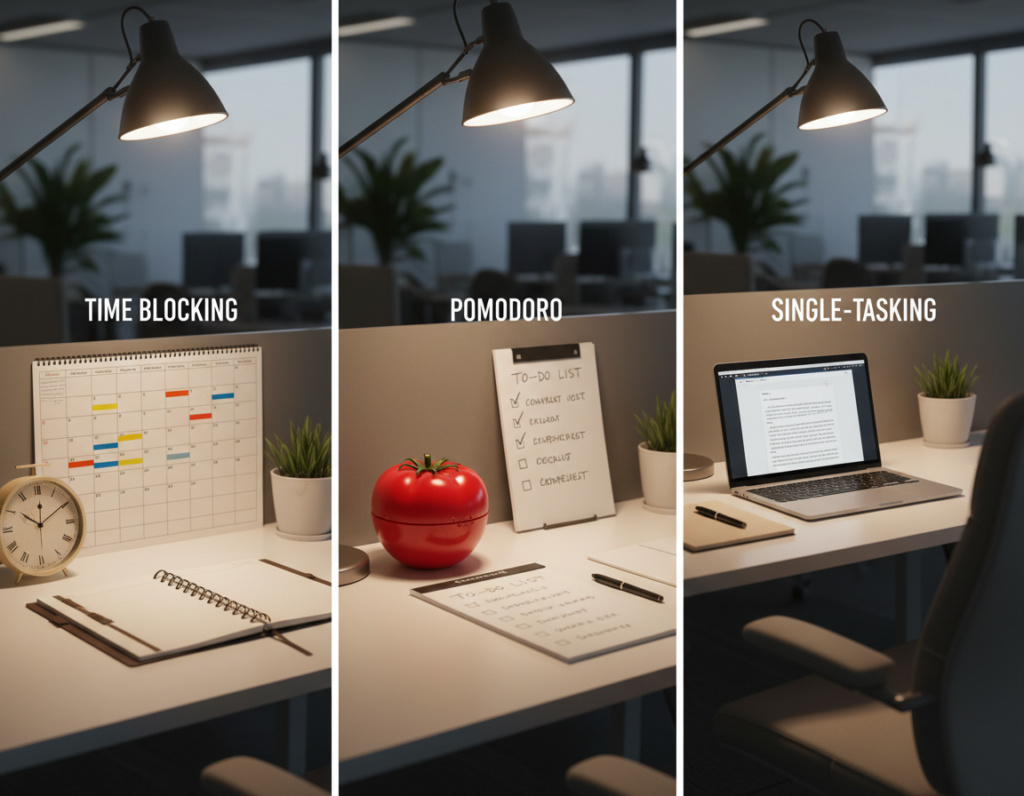
| Single-tasking rules | Deep focus, fewer errors | Slower throughput if misapplied | Writers, analysts |
| Time blocking | Predictable routine, clear boundaries | Rigid scheduling may clash with interruptions | Knowledge workers, students |
| Break scheduling (pomodoro) | Balanced work/rest, easy start | Not ideal for long creative flow | Short tasks, exam prep, caregivers |
Practical next step: choose one item from each table and run a two-week practice. Measure time-on-task, fewer errors, or faster completion as a simple test of whether the chosen combination fits daily demands.
Strategies and Activities to Build Attention Skills in Children and Students
Simple, playful routines help children convert bursty interest into steady task effort.
Brain breaks reset focus without derailing the day. Examples: five deep breaths, a 90‑second stretch, a brief walk, quick hydration. Keep breaks time‑boxed so the child returns easily.
Mindfulness and visualization drills are short and scalable. Try a 2‑minute object focus challenge, then lengthen it by 30 seconds weekly. Use the “white space” imagery: imagine painting a room white to clear mental clutter.
Games and movement
Memory and impulse control games—Memory, Simon Says, Guess Who?—extend working memory while practicing rules. Freeze games, simple yoga flows, trampoline bursts, or an obstacle course prime the body before a class or homework block.
Listening supports and home routines
In class or at home, ask the child to paraphrase directions and use auditory cue games like “Where’s the Timer?” for listening practice. For chores, give clear, concise steps and use reward sequencing: boring task, then preferred activity.
Support and individual needs
Children with adhd or sensory sensitivity benefit from reduced noise and visual clutter, visual schedules, and timers. Track small metrics—time‑on‑task, fewer reminders—and share patterns with teachers or clinicians when functional struggles persist. For practical planning and clarity, caregivers can visit mental clarity and focus resources.
Conclusion
A clear, repeatable system turns brief wins into a longer span of usable focus.
Summary: The core promise is that attention is trainable when the brain’s basics—sleep, movement, and stable nutrition—combine with brief mindfulness, planned breaks, music choices, and single-tasking rules.
Readers should pick a small starter stack for two weeks: one baseline habit, one practice, and one boundary. Measure results by completed tasks, fewer errors, or less re-reading.
If problems persist, especially with mood, sleep, or suspected ADHD, seek professional support. For a practical routine that aligns with this system, explore a focus-first workday.
Result: steady reps yield a longer span, lower stress, and more satisfying work and life outcomes.