Can a simple set of repeatable habits lift team output and sharpen decision-making? This guide explains a clear, practical path. It defines focus strategies as repeatable methods to strengthen cognitive performance in knowledge work, not a marketing plan.
Readers in the United States will learn to diagnose distractions, pick techniques, build a system, lead teams, and measure results. This section previews why it matters: modern work patterns make sustained attention scarce, and improving it raises quality and execution reliability.
Evidence from working memory limits and cognitive control research supports the approach. The guide gives step-by-step selection rules, implementation checklists, and adaptable templates.
Expect a how-to orientation: readers leave with a personal plan and leadership norms, not only theory. Later pages include comparison tables to match methods to task types and goals.
Why focus strategies matter for cognitive performance in today’s distraction-heavy workplace
In today’s offices, attention has become a measurable business constraint that shapes output and costs. Cognitive performance in US knowledge work means the capacity to deliver high-quality results with speed and accuracy while handling complexity, ambiguity, and heavy communication loads.
Cognitive performance shows up in real artifacts: fewer spreadsheet errors, clearer reports, faster project cycles, and better decisions in meetings.
Hidden costs: interruptions and context switching
Interruptions cost U.S. firms an estimated $588 billion per year (Basex). After a disruption it took an average of 23 minutes and 15 seconds to regain concentration (Gloria Mark, UC Irvine).
“After an interruption it took an average of 23 minutes and 15 seconds to regain focus.”
- Context switching adds recovery time and raises error rates (~20% increase in experiments).
- Each switch fragments strategic thinking and slows throughput.
- Operational outcomes include missed deadlines, rework, slower innovation, and weaker customer response.
Protecting high-cognitive-load blocks is a tactical resource, like preserving budget or engineering capacity. The rest of this guide will define precise methods, separate them from market-level business strategy, and show how to pick and measure the best approach for teams and individuals.
What are focus strategies
Defining repeatable methods to guard attention makes sustained work predictable and measurable.
Repeatable methods that direct attention to high-impact goals
Operational definition: focus strategies are repeatable methods a person or team uses to allocate attention to the highest-impact work and sustain it long enough to finish. This definition ties daily choices to measurable output and clear goals.
In practice, workplace behaviors include choosing one priority, structuring the day, reducing triggers, and applying rules for what to ignore or defer. These habits convert policy into action and lower friction during deep work.
Distinguishing attention from sustained concentration
Attention is the broader ability to notice and shift between stimuli. By contrast, sustained concentration is selective attention held on a task feature or goal.
This distinction matters: many people attend to everything—messages, dashboards, meetings—but never achieve deep processing that creates value. Two useful categories follow: attentional focus (shielding from external stimuli) and cognitive focus (deep reasoning and synthesis).
The article’s approach is practical: build a toolkit of methods, then assemble a personal “focus operating system” that survives interruptions. That method helps transition from theory to a successful focus strategy in real work settings.
Clearing up confusion between cognitive focus strategies and business focus strategy
The phrase “focus strategy” often bundles two different practices under one label. This creates misunderstanding for leaders, analysts, and teams trying to improve attention or market position.
Overlap exists in three simple rules: say no, pick constraints, and allocate scarce resources. A company narrows product scope and budget. An individual limits interruptions and working memory load. Both choices raise the chance of success.
Divergence matters. Business strategy aims to win a niche or group within a market by out-serving competitors. Cognitive practice aims to regulate attention, cut distraction, and lift task performance.
- Example: a company targets a niche market to reduce competitors; an analyst targets a narrow set of deliverables to cut context switching.
- Translation benefit: Porter-style segmentation can be a mental model for attention allocation without turning this into marketing advice.
Readers should borrow strategic thinking to set commitments, but use brain-based methods to manage notifications, emotions, and fatigue. The next section explains the cognitive foundations—prefrontal control and working memory—that show why these tactics work reliably.
The cognitive science foundations behind sustained focus
Sustained mental effort stems from networks in the brain that filter inputs and keep goals active long enough to produce work. This section links neuroscience to simple actions people can use at work.
Cognitive control and the prefrontal cortex
The prefrontal cortex governs planning, inhibition, and rule maintenance. It helps someone ignore a notification and keep task rules in mind during complex problem-solving.
Working memory limits and why multitasking backfires
Working memory holds only a few items at once. Trying multiple tasks forces constant reloading of details. Rapid task switching raises error risk and wastes recovery time.
Sensory distractions versus emotional distractions
Sensory triggers include noise, pop-ups, and visual clutter. Emotional triggers include stress, worry, and high arousal described by Daniel Goleman. Each type needs a different remedy.
Practical implication: change the environment to cut sensory triggers and change interpretation or routines to manage emotional ones. Better control of these elements improves quality, cuts rework, and frees time for higher-level innovation.
| Cognitive Element | Work Role | Quick Fix |
|---|---|---|
| Prefrontal control | Planning, inhibition | Scheduled deep blocks, notification rules |
| Working memory | Hold & manipulate details | Use notes, reduce simultaneous threads |
| Distractor type | Sensory vs emotional | Environment edits vs routine changes |
Common causes of poor focus and how to diagnose them
Many teams lose productive hours to small interruptions that never show up on a timesheet. Begin by diagnosing which failure mode dominates: external interruption, internal overload, or systemic ambiguity. That lens guides which fixes to try first.
Technology drives micro‑interruptions. Notifications, email floods, and open tabs create frequent context switches. Messaging apps fragment attention and eat useful time.
Meeting load can fragment the workday into “schedule confetti.” Back-to-back sessions remove long blocks needed for deep work and raise switching costs.
Internal distractors and organizational roots
Stress, fatigue, and job uncertainty consume working memory. When the mind ruminates, simple tasks take longer and errors rise.
Operational chaos—unclear priorities, shifting directives, and poor leadership—forces constant re‑prioritization. Teams react instead of delivering planned value.
- Symptoms managers see: missed deadlines, lower quality, missed follow-ups, and rising irritability.
- Signs individuals report: forgetfulness, longer cycle times, and more reliance on caffeine or stimulants.
| Cause | Diagnostic sign | Near-term business impact |
|---|---|---|
| Notifications & email | Many short interruptions per hour | Slower delivery, more small errors |
| Meeting overload | No uninterrupted blocks longer than 90 minutes | Lower creative output, delayed products |
| Stress/fatigue | Frequent rumination, missed details | Reduced quality, poor customer response |
| Operational chaos | Conflicting priorities, rework | Wasted time, frustrated teams |
Next step: different causes need different interventions. The comparison table that follows helps pick the right technique instead of relying on trial‑and‑error.
A structured comparison table of focus techniques that improve cognitive performance
This table groups practical methods so a person can choose by task demand, setup cost, and likely payoff.
Use the grid below to match scheduling protocols, workspace design, and recovery habits to real work constraints. Each row gives a quick start step for immediate gains.
| Category | Best for task type | Setup time | Cognitive load reduced | Typical pitfalls | How to start in 10 minutes |
|---|---|---|---|---|---|
| Deep work blocks | Complex analysis, writing | 5–10 min | High (working memory) | Overlong sessions, no stop rule | Pick one goal, phone out, 50/10 timer |
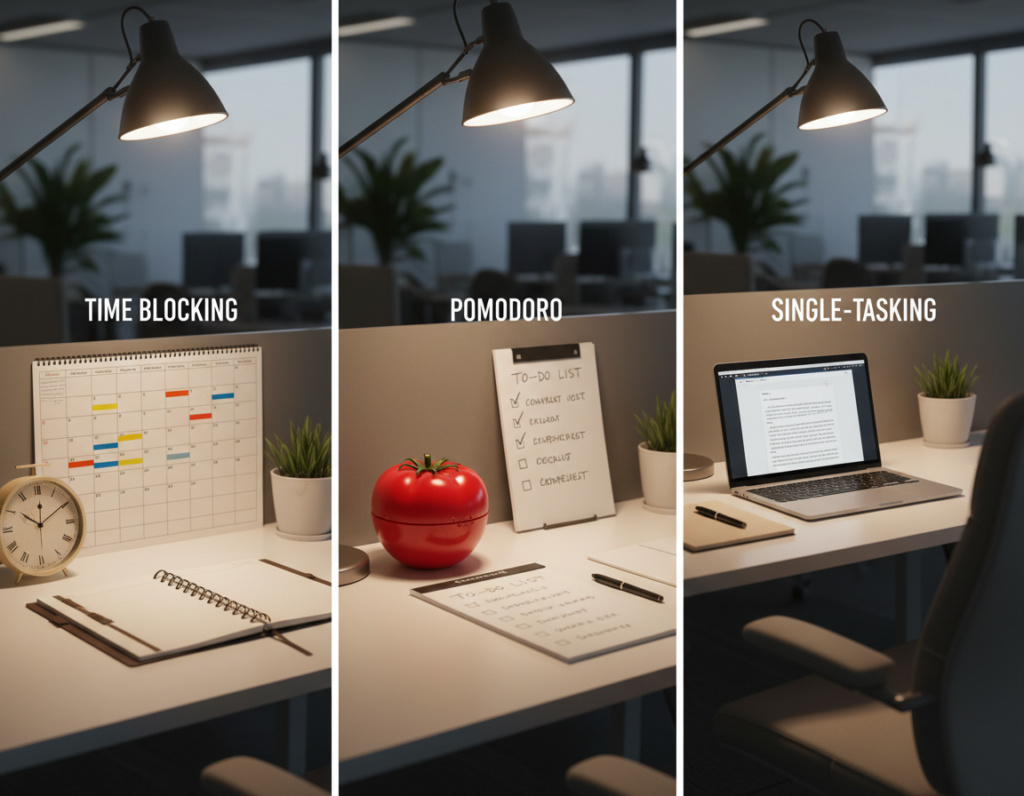
| Time blocking | Mixed-day planning, meetings + heads-down | 10–15 min | Medium (switch cost) | Overfilled calendar, no buffers | Reserve 90-min block, add 15-min buffer |
| Single-tasking protocol | Routine deliverables, coding | 2–5 min | Low–medium (context switches) | Task list creep, tab overload | One list, one window, one timer |
| Environmental design | Open-plan or home offices | 5–20 min | Varies (sensory) | Too many rules, poor adoption | Batch notifications, clear desk cue |
| Recovery & pacing | Sustained projects, long weeks | 5 min daily | Emotional & fatigue load | Skipping breaks, poor sleep | Micro-break every 60 min, scheduled sleep window |
Concrete example
A product analyst uses a 90-minute deep block for report drafting, turns off desktop badges, and takes a 10-minute walk mid-block. This single mix raises delivery quality, saves time, and preserves the ability to review with fresh eyes.
How to choose the right focus strategy for the task, time horizon, and goal
Match the simplest protective habit to the work at hand and scale only when necessary. The best selection rule prevents overengineering: pick the smallest intervention that protects attention long enough to finish a task.
Match by task type
Creative work: use longer uninterrupted blocks and looser structure during idea generation. Tighten the schedule for editing and final drafts.
Analytical work: favor deep work blocks, single-task windows, and clear stopping points to reduce errors and mental fatigue.
Administrative work: batch emails, use checklists, and run short, time-boxed sprints so low-value tasks do not expand.
Match by time constraints
- Minutes — quick resets, two- to ten-minute timers for refocus.
- Hours — protected blocks, meeting rules, and planned buffers.
- Weeks — cadence, OKR alignment, and workload design to preserve long-term goals.
Trade-offs: stronger protection raises quality but needs coordination and clear boundaries with stakeholders.
Practical adaptations: in open offices use visible cues and headphones; client-facing roles combine short protected blocks with scheduled touchpoints; hybrid teams set shared norms for overlapping hours.
Building a personal focus strategy that holds up under pressure
A compact personal system keeps attention steady when deadlines tighten and meetings multiply.
Step-by-step build process: define desired outcomes, pick simple rules, set clear boundaries, and rehearse distraction handling before pressure hits. Start by listing two daily goals and one weekly outcome to limit working-memory load.
Goal setting that reduces cognitive load
Fewer active goals means less mental churn and fewer open loops. Use a “Top 1 for today” rule and record progress in one place to free cognitive space.
Prioritization rules that prevent “everything is urgent”
Require that each task either moves a key deliverable forward or it is deferred. This forces explicit trade-offs instead of endless additions to the task line.

Boundary setting with email, messaging apps, and meetings
Block two scheduled email windows, set messaging status norms, and apply meeting acceptance criteria that protect long blocks without killing responsiveness.
Designing a distraction-handling plan
Create short scripts for sensory triggers (silence notifications, use headphones) and emotional triggers (capture worries in a quick note, defer decisions). Rehearse these steps so they work under stress.
Creating consistent routines that protect attention
Adopt a start-of-day plan, a pre-deep-work setup, and a shutdown ritual. Use a 3-step re-entry checklist after interruptions to restore momentum.
- Resilience tip: practice the system during normal weeks so it survives peak loads.
- Sustainability: the best approach scales when time pressure rises, not only on calm days.
Team focus management strategies for leaders and managers
Leadership sets the conditions that let teams do deep work instead of chasing interruptions. A manager acts as an attention architect, shaping priorities, meeting load, and communication defaults so the company spends time on high‑impact work.
Clear goals and expectations to reduce ambiguity
Define two clear daily goals and one weekly outcome for each team member. Clear goals cut ad hoc requests and rework, reducing context switches and preserving working time.
Meeting hygiene and communication norms that preserve deep work
Apply simple meeting rules: agendas, a decision owner, strict time‑boxing, and regular no‑meeting blocks. Replace status calls with short written updates when possible.
- Set expected response times by channel and escalation rules.
- Declare quiet hours to protect overlapping deep blocks for the audience of stakeholders and customers.
- Use short scripts to push back on low‑value invites and to renegotiate deadlines with transparent trade‑offs.
Creating a culture of focus without burnout
Encourage breaks, realistic capacity planning, and recovery. A focus culture that demands constant intensity will harm morale and reduce business results.
“Good leaders protect heads‑down time and protect people from constant urgency.”
| Leader action | Quick rule | Benefit |
|---|---|---|
| Attention architect | Limit meetings to 40% calendar | More deep work time |
| Communication norms | Response windows per channel | Lower interruptions |
| Burnout guardrails | Mandatory breaks and buffers | Higher quality output |
Tie team practice to outcomes: better focus yields higher quality deliverables, faster cycle time, and more predictable execution that helps the business and the company succeed.
For practical implementation guidance, see a scientific checklist on team management and a guide to building a focus‑first workday: team focus checklist and focus‑first workday.
Using business focus strategy concepts to sharpen cognitive focus
Treating attention like a market helps people decide which tasks deserve premium time and which should be commoditized.
Market segmentation as an attention model
Segment work by value and cognitive demand: strategic, revenue/risk, and maintenance. Assign stronger protections to strategic items and lighter rules to routine work.
Cost focus versus differentiation focus as productivity trade‑offs
Cost focus reduces time per task with templates, automation, and standard checklists. It lowers effort for repeatable work.
Differentiation focus calls for deeper work and higher quality output. It raises perceived value for a target audience but takes more time.
| Approach | Main trade | Work example |
|---|---|---|
| Cost focus | Speed over polish | Batch reporting, macros |
| Differentiation | Depth over volume | Long-form analysis, signature deliverable |
| Niche attention | Specialize a capability | Forecasting, incident response |
Niche market thinking and examples
Choose a narrow attention niche to dominate. Ferrari and Rolex show how a limited offering builds brand loyalty through distinct quality. Action illustrates a cost model: a tight range plus fast execution.
Hidden Champions prove deep specialization pays over time. They teach deliberate practice, steady investment, and resisting the urge to spread effort across many small tasks.
Frameworks and models to operationalize focus strategies over time
A durable system combines decision filters, risk checks, and measurable goals to keep attention improvements alive.
Use frameworks as maintenance systems: treat them like regular service checks so gains persist beyond initial effort.
Porter-style decision filter for commitments
Porter’s generic approaches help choose commitments. A person or team can decide if a task needs speed (cost-like), standout quality (differentiation-like), or a narrow scope (focus-like).
- Apply the filter before saying yes to new work.
- Record the chosen approach on the task card to keep alignment.
SWOT and PESTEL adapted for personal and team risk
Use a compact SWOT: strengths (best deep-work hours), weaknesses (notification habits), opportunities (automation), threats (meeting creep).
Run a lightweight PESTEL scan to spot external risk: policy shifts, new tools, economic pressure, and compliance demands that raise load.
OKRs to turn attention into measurable outcomes
Define one objective tied to a business result, then set key results that map to protected time and outputs.
| Objective | Key Result | Metric |
|---|---|---|
| Reduce project cycle time | Two deep blocks/day | Average days per ticket |
| Improve report quality | Fewer reopened tickets | Reopen rate (%) |
| Raise sustained attention | Weekly review cadence | Adherence rate (%) |
Cadence and simplicity: weekly review, monthly adjustment, quarterly reset. Keep a one-page dashboard and a short review ritual so the successful focus strategy lasts.
Measuring results with KPIs and a comparison table of productivity frameworks
Begin measurement by aligning metrics to outcomes rather than hours logged. This measurement philosophy judges protected work by quality and speed, not by visible busyness.
KPIs that indicate improvement
Practical examples include output quality scores, average cycle time, and error rates or rework frequency. For teams, add percentage of planned deep-work blocks completed and customer loyalty signals tied to delivery quality.
Retention and loyalty analogs
Map engagement to showing up for planned work, follow-through to task completion, and habit adherence to consistency over weeks. These business-style metrics predict durable gains in productivity and brand reputation.
Running controlled tests
Change one variable—notification batch times, meeting-free mornings, or desk layout—for two weeks. Track the KPIs above and compare cohorts. Use A/B testing to identify high-payoff rules before scaling.
Sustainability and competitive advantage
Measure whether gains persist after disruptions like travel or launches. Track retention, margin changes, and market signals to see if improvements convert into lasting growth.
| Framework | Best use case | Measurement fit | Common failure modes |
|---|---|---|---|
| Time blocking | Mixed days with meetings | Planned blocks completed (%) | Overfilled calendar, poor buffers |
| Pomodoro pacing | Short focused tasks | Task throughput per hour | Interruptions during pomodoros |
| Kanban WIP limits | Flow and handoffs | Cycle time, WIP levels | Hidden queues, policy drift |
| OKR-linked blocks | Outcome-driven projects | KR progress, quality metrics | Misaligned objectives, metric overload |
Measurement turns small improvements into compound advantages. For a business-level playbook on sustaining gains, see the guide to sustainable business growth.
Risks, constraints, and ethical considerations when optimizing focus
Any program that raises sustained attention can create new limits if it is applied without care. Leaders should weigh short-term gains against long-term risks. This balance protects growth and preserves team adaptability.
Over-specialization and rigidity
Narrowing attention too aggressively reduces learning and cross‑team ability. A company that locks a group into a single niche may lose versatility when priorities shift.
Mitigation: keep a core niche for high-value work and reserve a small allocation for training, exploration, and relationship work. That preserves learning while keeping execution reliable.
Burnout risk and recovery
Sustained concentrated work needs recovery. Without breaks, sleep, and pacing, cognitive control weakens and error rates rise.
Practical step: build mandatory micro-breaks, enforce reasonable schedules, and track wellbeing metrics alongside productivity measures.
Privacy, trust, and ethical measurement
Measurement must remove obstacles, not punish people. Surveillance-style monitoring erodes trust and undermines the very autonomy that enables deep work.
Ethical guidance: co-design norms with teams, be transparent about data use, and set clear limits on personal monitoring. For customer‑facing or incident roles, adapt the approach so responsiveness needs do not become blame for individuals.
Well-designed focus strategy supports durable performance by combining protection with exploration, recovery, and respectful measurement. Sustainable, ethical systems yield steady business growth and a resilient group culture.
Conclusion
, Focus strategies are repeatable methods that direct attention to high‑impact goals and sustain cognitive effort long enough to produce quality outcomes.
The article traced distraction costs → cognitive science → diagnosis → a techniques table → selection rules → a personal system → team norms → measurement → ethics. Readers can use that chain as a simple playbook.
This week’s implementation: pick one high‑value deliverable, schedule two deep work blocks, reduce notifications, and track one KPI tied to time or errors. Leaders should clarify priorities, protect deep work time, and set clear communication norms that avoid burnout.
Think like a brand: Ferrari and Rolex illustrate quality focus, Action shows efficiency, and Hidden Champions show niche strength. The payoff is practical — faster delivery, fewer errors, better reliability, and sustained performance when paired with recovery and ethical norms.